How Net Metering Works in Oregon
Net metering lets Oregon solar owners earn credit for the extra power they send to the grid.
Beyond the immediate benefit of producing your own clean energy, a state-level policy called net metering in Oregon fundamentally transforms your relationship with the electric grid, turning your home into a mini power station that can actually earn you credit.
While it sounds technical, the concept is simple: you get full, one-to-one credit for the extra solar power you produce and send to the grid. As a licensed Oregon electrical contractor (CCB 202002), in business since 2013, we help homeowners understand how this program can lower their electricity bills.
This comprehensive guide will walk you through exactly how it works, what to expect on your bill, and how to get the most from your system.
What is Net Metering, Really? An In-Depth Look
At its core, net metering is a billing arrangement that credits solar energy system owners for the electricity they add to the electrical grid. Think of the grid as a massive, shared energy bank. On a sunny Oregon afternoon, your REC solar panels might be producing far more power than your home is using. Instead of letting that valuable energy go to waste, it flows out through your meter and into the grid, supplying clean power to your neighbors.
Your utility company installs a special "bi-directional" meter that tracks this two-way flow: power you draw from the grid and power you send to the grid. For every kilowatt-hour (kWh) of power you export, you receive a kWh credit on your account. Later, when your panels aren't producing - at night or on a cloudy winter day - you draw power from the grid as you normally would. But instead of paying the full retail rate for that electricity, you first draw from your bank of accumulated credits.
This critical one-to-one credit is what makes Oregon's program so valuable. You are credited at the full retail rate for the power you export, the same rate you would have paid for it. This policy, supported by the Oregon Public Utility Commission (PUC), ensures you receive maximum value for your solar investment.
How Does Net Metering Work in Oregon, Step-by-Step?
Net metering in Oregon works automatically: your meter tracks the power you send to the grid and the power you use. Once your system is installed and approved by the utility, the magic happens behind the scenes every single day.
- Peak Sun, Peak Production: During the day (roughly 9 AM to 5 PM), your panels are at their peak. They convert sunlight into direct current (DC) electricity, which is then converted by an Enphase microinverter into alternating current (AC) that your home can use. This clean energy powers your lights, appliances, and electronics first.
- Exporting Your Surplus: If you're at work and the house is empty, your energy production will likely exceed your consumption. This surplus power is automatically exported to the grid.
- Earning Your Credits: Whether you have PGE net metering or Pacific Power net metering, your bi-directional meter precisely records every exported kWh. Your utility account is credited for this amount. This is how the power you export earns credit on your bill.
- Using Credits at Night: As the sun sets, your panels stop producing. Your home begins drawing electricity from the grid. However, your utility will apply your banked credits to offset this usage before charging you for any new consumption.
This daily cycle allows you to leverage the long days of summer to build up a bank of credits that can reduce your electricity bills during the darker, rainier months.
Net metering example: the annual cycle
In a typical year, net metering lets a solar household build up credits in summer and use them in winter. Picture a typical household:
- In July: Their system produces 1,100 kWh of energy. They only use 700 kWh during the day, so they export a surplus of 400 kWh to the grid, "banking" it for later. Their bill is likely just the small monthly base connection fee.
- In November: The shorter, cloudier days mean their system only produces 350 kWh. Their home, however, uses 800 kWh. Instead of paying for the 450 kWh difference, they automatically draw from the 400 kWh surplus they banked in July. They only have to pay for the remaining 50 kWh.
At the end of a 12-month period, your utility does an annual "true-up." If you have any credits left over, the policy varies. For most residential customers of PGE and Pacific Power, these excess credits are granted to the utility without payment. This is why expert system design is crucial - we size your system to match your annual usage, so you don't leave value on the table.
Pairing Net Metering with Battery Storage
Net metering does not keep your power on during an outage, but pairing it with battery storage does.
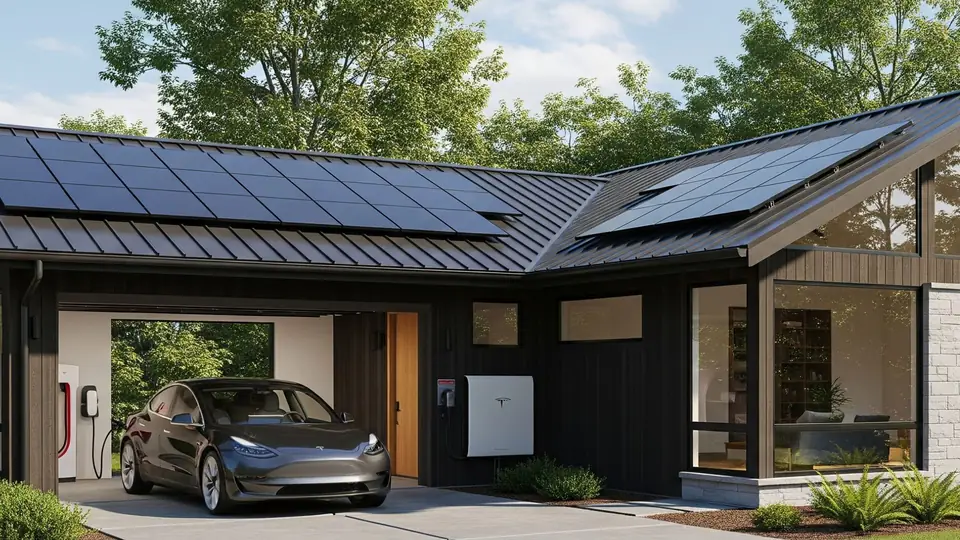
This is where adding a home battery backup system, like an Enphase IQ Battery, gives you a more resilient energy setup.
- Energy Resilience: During a grid outage, a solar-only system will shut down for safety. A battery, however, allows you to use your stored solar energy to keep critical circuits running during an outage.
- Maximize Self-Consumption: With a battery, you can store your excess solar power instead of sending it all to the grid. Then, at night, you can use your own stored energy first before drawing from the grid. This gives you more control over your power.
- Protection from Policy Changes: While Oregon's net metering program is strong, policies can change. Owning a battery ensures you can always store and use your own energy, making you less dependent on utility programs.
Maximize Your Savings with Energy Solutions
Energy Solutions helps you maximize savings by understanding the Oregon solar incentives that apply to you. Net metering is the cornerstone, but maximizing its potential requires a professional, experienced partner.
At Energy Solutions, we are more than installers - we are your local energy consultants. We handle every single step of the process with a transparent, "no surprises" approach:
- Expert System Design: We analyze your energy usage to design a system that maximizes your net metering credits without significant overproduction.
- Full-Service Interconnection: We manage all the complex paperwork and applications with PGE or Pacific Power to get your system approved and enrolled in the net metering program.
- Quality Solar Installation: Our experienced, local electricians install equipment from brands like REC and Enphase to build a system that serves you for many years.
Are you ready to see how you can leverage Oregon's net metering program to turn your roof into a power-generating asset and watch your electricity bills shrink?
Schedule your free, no-obligation consultation today! Call us at (971) 526-5545 or fill out our online form to get a detailed, transparent quote.